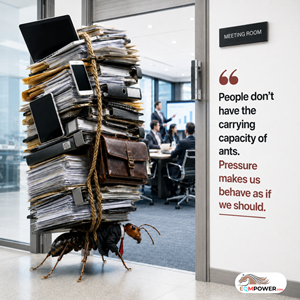
The average ant species can carry around 20 to 50 times its own body weight. The Asian weaver ant can carry as much as 100 times its weight.
We humans can't do that. Yet when the pressure mounts, we remarkably often respond as though taking on more is the only sensible answer.
I spent years in positions of responsibility where working under intense pressure was the norm. For a long time, I believed that pushing myself even harder was a sign that I was performing well. Putting in more energy, moving faster, solving yet another problem, adding a few extra hours to the working day. Taking on more made me feel that I was making a difference.
In reality, however, I wasn't growing. I was becoming exhausted, and my effectiveness was steadily declining.
I often see the same pattern in organisations where pressure and competition run high.
There are even professionals who proudly describe themselves as adrenaline junkies. These days, that's a major red flag for me when considering whether to hire someone.
Because this attitude is so often normalised, it doesn't look like a strategic risk. It looks like responsibility, effectiveness and decisiveness. And in the short term, working harder does produce results. More emails get answered, more decisions get made, and more problems get swept off the table.
There will always be times when a situation calls for temporarily working harder and putting in more energy. Our stress response system is specifically designed to make additional energy available when we face acute pressure.
The problem arises when the pressure remains consistently high and that response becomes less and less temporary.
At that point, it may still feel as though you're consciously pulling out all the stops, when in reality the sequence is reversed: the pressure has already triggered your stress response. Only then does your mind come up with a convincing story about why all this extra effort is absolutely necessary.
That distinction is crucial to effective leadership. Once working harder becomes an automatic response, you've skipped one essential question:
Is putting in more effort really the most effective choice in this situation?
It's precisely when you're under pressure that you need to be able to see the bigger picture, take in new information and continue assessing what the situation actually requires. Yet at the same time, your stress response narrows your attention, making you more likely to base decisions on what is familiar rather than on the full picture.
Leaders who learn to recognise earlier when their nervous system is beginning to narrow their choices can interrupt that reflex sooner and remain better able to see what the situation needs.
You don't turn into an ant under pressure. When taking on more becomes a reflex rather than a choice, your ability to maintain a strategic overview quickly pays the price.
I'm curious how you handle this when you reflect on recent situations in which the pressure was mounting:
Do you consciously choose to do more? Or is it an automatic response?
Comments